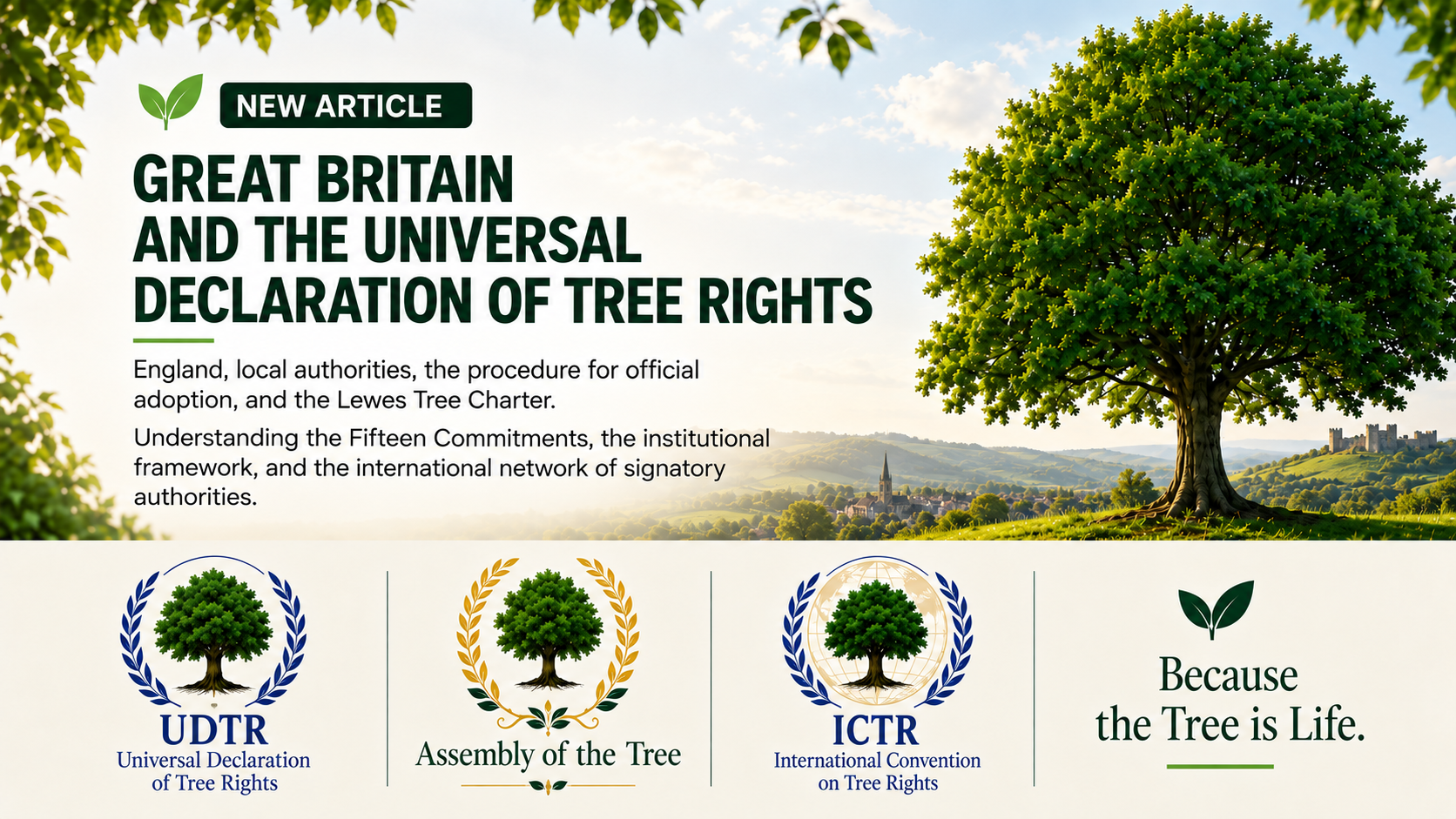
This analysis examines the conditions under which a local or regional authority in Great Britain may formally adopt the Universal Declaration of Tree Rights and the Fifteen Commitments of Local and Regional Authorities, and then organise their progressive implementation within the applicable legal framework. It focuses in particular on England and on the case of Lewes, East Sussex, where Lewes Town Council unanimously approved a distinct municipal Tree Charter on 10 September 2026.
The central question is therefore: how can a British local authority recognise the principles of the Universal Declaration of Tree Rights and implement the Fifteen Commitments without claiming powers that the law has assigned to another authority?
For England, the answer is positive at the level of institutional policy, internal governance and the lawful exercise of existing local powers. Adoption does not create a new source of English law, does not confer legal personhood on Trees, and does not convert a town council into a planning, forestry or enforcement authority where Parliament has vested those functions elsewhere.
The Universal Declaration of Tree Rights is the founding text of an institutional initiative carried and developed by La Compagnie des Papillons Bleus, which maintains the official corpus, its documentary continuity, institutional guidance and follow-up.
For an adoption to be recognised and recorded by La Compagnie des Papillons Bleus as an official adoption within the institutional framework of the Declaration, the authority must contact La Compagnie before any resolution, motion or signature intended to form part of the official procedure. Under the current framework, official adoption jointly and fully covers the Declaration and the Fifteen Commitments; implementation is progressive and adapted to lawful powers, resources and territorial circumstances.
Once the official procedure and institutional formalisation have been completed, the authority may be entered in the International Register of Signatory Authorities. The Register provides institutional traceability and visibility, facilitates cooperation among signatory authorities, encourages the sharing of experience and good practices, and contributes to an international network through which local knowledge, methods, results and territorial experience can circulate. The international Assembly of the Tree complements this function by providing a forum for dialogue, cooperation and the circulation of scientific, legal, civic and territorial knowledge.
The reference corpus for British authorities
Any British authority considering official adoption should work from the current official English corpus published on the Universal Declaration of Tree Rights website. The following resources are the principal points of reference:
- Understanding the Universal Declaration of Tree Rights
- Legal Foundations of the Universal Declaration of Tree Rights — official English edition on the quadrilingual page
- What Does It Mean to Recognise Rights of the Tree? — official English edition on the quadrilingual page
- Official Framework of the Universal Declaration of Tree Rights — official English section
- Local Authorities and the Universal Declaration of Tree Rights: Principles, Procedure and Legal Scope
- Three Founding Articles — official English PDF
- The Fifteen Commitments of Local and Regional Authorities — official English PDF
- Assembly of the Tree
- Collaborate — Local and Regional Authorities
These resources must be read together. The Declaration provides the founding principles; the Fifteen Commitments provide the common implementation roadmap; the Official Framework governs institutional representation and adoption; and the local-authority procedure explains the steps that must be followed before, during and after the vote.
1. Legal and institutional nature of the Declaration
The Universal Declaration of Tree Rights establishes three founding Articles concerning recognition, respect, protection and responsibility towards the Tree. The institutional initiative surrounding it is ethical, scientific, normative, legal, democratic, cultural and educational.
The Declaration is not an institutional branch of the Rights of Nature movement. It may share environmental-protection objectives with other approaches, but it follows an autonomous framework and does not make legal personhood, judicial standing or litigation on behalf of nature a necessary foundation of Tree Rights.
The Declaration is not an Act of Parliament, a statutory instrument, a treaty in force, a judgment, a planning policy, a public authority or an intergovernmental organisation. Its adoption by a British authority therefore does not amend domestic law or displace statutory powers.
Under the current official framework, adoption by a local or regional authority is linked to the simultaneous and full adoption of the Fifteen Commitments of Local and Regional Authorities. The Declaration states the foundation; the Fifteen Commitments organise the progressive institutional roadmap.
Official adoption does not automatically confer legal personhood on Trees, create independent litigation capacity, transfer public powers to La Compagnie des Papillons Bleus, alter public or private ownership, create offences or sanctions, or constitute adherence by the United Kingdom to the separate proposed International Convention on Tree Rights.
2. Great Britain, the United Kingdom and devolved legal systems
Great Britain comprises England, Wales and Scotland. The United Kingdom comprises Great Britain and Northern Ireland. These terms must not be used interchangeably in a legal implementation guide.
Local government, planning, biodiversity, forestry and environmental regulation are substantially affected by devolution. A procedure legally appropriate for an English town council cannot simply be copied into Wales or Scotland.
One Declaration — different legal routes
The official text of the Declaration and the Fifteen Commitments remains common. What changes is the legal machinery used by each authority to implement them: the competent body, statutory powers, planning system, forestry controls, biodiversity duties, consultation rules, financial procedures and sector-specific permissions.
This article therefore provides a Great Britain framework but a detailed operational analysis for England. Sections 20 and 21 identify the principal differences for Wales and Scotland.
3. Town and parish councils in England: what a Town Council legally is
English local government is multi-layered. Depending on the area, functions may be divided between parish or town councils, district councils, county councils, unitary authorities, combined authorities, national park authorities and other statutory bodies.
Under the Local Government Act 1972, a parish may acquire the status or style of a town and its parish council may consequently be called a Town Council. This does not transform it into a district or principal council and does not automatically transfer planning, highway, forestry or regulatory functions to it.
A town council may nevertheless exercise a range of statutory functions, manage land and facilities, employ staff, enter contracts, support community projects, make representations, participate in neighbourhood planning and — where the statutory conditions are met — use the General Power of Competence.
4. General Power of Competence: an important but conditional legal basis
Sections 1 to 8 of the Localism Act 2011 establish a General Power of Competence. In broad terms, a qualifying local authority may do anything that individuals generally may do, subject to statutory limitations and restrictions.
For parish and town councils, however, this power is available only to an eligible parish council. Eligibility is governed by the Localism Act and the Parish Councils (General Power of Competence) (Prescribed Conditions) Order 2012.
At the time the relevant resolution is passed, the Order requires, in substance, an electoral mandate, a qualified clerk and the prescribed relevant training: at least two-thirds of the members of the council must hold office as a result of having been declared elected rather than co-opted; the clerk must hold one of the prescribed or successor local-council qualifications; and the clerk must have completed the relevant training in the exercise of the General Power of Competence unless that training formed part of the qualifying course. The council must resolve that the prescribed conditions are met, and eligibility must be renewed in accordance with the statutory cycle.
The General Power of Competence can provide a useful basis for voluntary initiatives, partnerships, services, projects, grants and institutional action. It is not a power to ignore prohibitions, procedural requirements or functions allocated by Parliament to another body.
It cannot, for example, allow a town council to issue a Tree Preservation Order if it is not the local planning authority, grant or refuse planning permission where that function is vested elsewhere, create criminal offences, or replace a Forestry Commission felling licence.
5. The biodiversity duty: a strong statutory point of articulation
Section 40 of the Natural Environment and Rural Communities Act 2006, strengthened by section 102 of the Environment Act 2021, requires public authorities operating in England to consider what action they can properly take to further the general biodiversity objective, determine appropriate policies and objectives, and act to deliver them.
The Government’s biodiversity-duty guidance applies the duty to public authorities. Town and parish councils are therefore required to fulfil the substantive duty within their functions.
Parish councils are excluded from the general statutory biodiversity-reporting duty applying to other local authorities and local planning authorities. That exemption from reporting does not remove the underlying biodiversity duty itself.
The Fifteen Commitments can therefore provide a structured method for a town council to organise inventories, canopy objectives, soils, public participation, project review, monitoring and long-term stewardship around a statutory duty that already exists in English law.
Important distinction
The Declaration does not create the biodiversity duty. English law creates the duty. The Declaration and the Fifteen Commitments can organise a coherent Tree-centred policy for discharging lawful functions in a manner consistent with that duty.
6. Three legal levels that must remain distinct
Level 1 — Principles and institutional policy
The competent council adopts the Declaration and the Fifteen Commitments and sets institutional objectives. The resolution does not by itself create generally enforceable duties for third parties.
Level 2 — Internal and proprietary measures
The authority acts through its own land, Trees, staff, budgets, procurement, contracts, maintenance standards, inventories, grants, consultation mechanisms and internal decision procedures.
Level 3 — Statutory controls affecting third parties
Planning decisions, Tree Preservation Orders, conservation-area controls, felling licences, enforcement notices, planning obligations, highway powers, offences and sanctions require the competent statutory authority, the correct legal basis and the prescribed procedure.
Official adoption of the Declaration does not collapse these three levels into one.
7. Tree Preservation Orders and conservation areas
Tree Preservation Orders are a central instrument of English Tree law. Under the Town and Country Planning Act 1990 and the Tree Preservation (England) Regulations 2012, a local planning authority may protect individual Trees, groups of Trees or woodlands where it considers protection expedient in the interests of amenity.
The Government’s planning guidance on Tree Preservation Orders and conservation areas explains that cutting down, topping, lopping, uprooting, wilfully damaging or wilfully destroying a protected Tree generally requires the local planning authority’s written consent, subject to statutory exceptions.
Separate notification requirements apply to many works to Trees in conservation areas where no Tree Preservation Order already applies.
8. Felling licences, forestry law and hedgerows
The Forestry Commission’s guidance states that a felling licence is normally required to fell growing Trees in England unless a statutory exemption applies. Felling without a licence where one is required is an offence.
This regime is distinct from planning controls, Tree Preservation Orders and conservation-area rules. A project may therefore need to be assessed through more than one legal route.
The Hedgerows Regulations 1997 create a separate regime for certain countryside hedgerows. Where the Regulations apply, the local planning authority processes the removal notice and consults the relevant parish council.
The Ninth Commitment — Regulate Felling — must be implemented accordingly. A town council can strengthen its own decision standards, require conservation to be examined before removal on its own land, record losses and replacements, make representations and educate residents. It cannot replace statutory felling, TPO, conservation-area or hedgerow regimes.
9. Ancient woodland, ancient Trees and veteran Trees
Natural England and the Forestry Commission treat ancient woodland, ancient Trees and veteran Trees as irreplaceable habitats. Their standing advice is a material planning consideration for local planning authorities.
The official standing advice requires decision-makers to consider direct and indirect impacts on soils, roots, water, ecological connections, pollution and the long-term integrity of such habitats. The guidance emphasises avoidance and reduction of harm and states that their irreplaceable character must be reflected in planning decisions.
This framework strongly supports the logic of several Fifteen Commitments: recognising Guardian Trees, preserving the vital environment of Trees, assessing projects before decisions, prioritising conservation and treating compensation as a last resort rather than a licence to destroy.
Doctrinal convergence
Planting a young Tree is not an ecological equivalent of losing an ancient or veteran Tree. English planning guidance already recognises the irreplaceable character of these habitats. The Declaration can reinforce the institutional discipline of avoiding loss before discussing compensation.
10. Planning and neighbourhood planning: from principle to land-use policy
Planning powers in England are statutory. A town council that is not the local planning authority cannot grant or refuse planning permission, impose planning conditions or make Tree Preservation Orders merely by adopting a policy resolution.
However, parish and town councils can play an important role in neighbourhood planning. Government guidance confirms that a parish or town council is a qualifying body capable of leading neighbourhood planning in its area.
A neighbourhood plan follows a statutory preparation, consultation, examination and referendum process. Once brought into force, its policies form part of the development plan used in planning decisions, subject to the wider statutory planning framework.
This makes neighbourhood planning one of the clearest routes through which lawfully drafted Tree-related objectives — canopy, green infrastructure, protection of significant Trees, soils, biodiversity and design — may move from an institutional commitment into the planning framework.
11. Private property, safety, evidence and proportionality
Official adoption does not alter title to land or Trees and does not create a general power to control private property. Measures affecting private owners must rest on a lawful statutory power and comply with the procedures and safeguards applicable to that power.
The Declaration also does not require the retention of a Tree where competent evidence establishes that intervention is legally necessary for public safety, infrastructure, plant health or another lawful purpose.
What it changes is the quality of decision-making: the authority is encouraged to identify the Tree’s condition and living environment, examine alternatives, distinguish genuine necessity from convenience, document the evidence, minimise harm and ensure that any intervention is proportionate to the lawful objective pursued.
12. Public assets, procurement, contracts and works: where implementation can be immediate
A local authority has its clearest operational control over Trees and land that it owns or manages, works that it commissions and contracts that it enters into within its lawful powers.
Progressive implementation may therefore include:
- inventories and condition records for Council Trees;
- root-protection and soil-protection requirements for public works;
- arboricultural method statements and competent supervision;
- watering, establishment and survival obligations for new planting;
- avoidance of unnecessary hard surfacing and soil compaction;
- maintenance specifications that avoid damaging pruning practices;
- contractual reporting on removals, replacements and establishment success;
- long-term management of veteran or habitat Trees;
- public disclosure of major Tree-management decisions.
Public procurement and contract management must comply with the Procurement Act 2023, its regulations and other applicable procurement duties. The Declaration does not displace procurement law; it can inform lawful specifications, outcomes and contract-management standards.
13. What an English adoption resolution may contain
A carefully drafted resolution may:
- adopt jointly and in full the Universal Declaration of Tree Rights and the Fifteen Commitments of Local and Regional Authorities within the official institutional procedure;
- identify and attach the exact versions of the documents adopted;
- state expressly that implementation will take place only within the Council’s lawful powers and functions;
- record the relevant statutory bases, including the biodiversity duty and, where verified, the General Power of Competence or other specific powers;
- instruct officers or a working group to prepare a phased implementation programme;
- audit Council-owned or managed Trees, soils and canopy;
- review maintenance, public works and procurement standards;
- establish or propose consultative institutions;
- provide for measurable indicators and periodic public reporting;
- identify the Council contact responsible for institutional follow-up, registration and exchanges with other signatory authorities;
- coordinate with the local planning authority, highway authority, Forestry Commission, National Park Authority and other competent bodies;
- identify which commitments require future planning, budgetary, contractual, policy or regulatory steps.
The resolution should avoid presenting as immediately enforceable any obligation that requires a separate statutory power, planning instrument, licence, contract, budget decision or regulatory procedure.
14. The Fifteen Commitments: a progressive implementation roadmap for English local authorities
The Fifteen Commitments of Local and Regional Authorities are not fifteen unrelated options. They form the institutional roadmap through which a signatory authority progressively gives effect to the Declaration.
Official adoption is joint and complete; implementation is progressive. An authority does not select only the commitments it prefers. It adopts the common corpus and then determines, commitment by commitment, what can be implemented directly, what requires another local act, and what depends on cooperation with another competent authority.
| Commitment | Possible English implementation | Legal safeguard |
|---|---|---|
| 1. Establish an Assembly of the Tree | Create or adapt a permanent consultative forum bringing together councillors, officers, arboricultural and ecological expertise, associations and residents. | Status, membership, transparency and advisory remit must comply with local-government law and standing orders. No statutory decision-making power is transferred automatically. |
| 2. Appoint a Defender of the Tree | Create an alert, scrutiny, recommendation and follow-up function; receive concerns and publish recommendations. | No automatic veto, enforcement, prosecution, planning or litigation power arises from the title. |
| 3. Recognize Guardian Trees | Identify Trees of particular ecological, historical, cultural, scientific or landscape significance. | Institutional recognition must not be confused with a TPO, conservation-area control or other statutory designation. |
| 4. Create the Guardian Tree Passport | Create a documented record including identification, location, ecological and cultural data, condition, photographs and known legal protections. | The Passport is an institutional tool, not a statutory title; data quality, privacy, access and security must be respected. |
| 5. Know the Trees of the Authority | Inventory Council Trees, map canopy and soils, record age classes, condition, vulnerabilities, habitat links and management history. | Distinguish verified data from estimates and Council land from the wider administrative area. |
| 6. Develop the Canopy | Set measurable canopy and resilience objectives and integrate them into lawful plans, assets and projects. | Planting does not justify avoidable loss of mature Trees; objectives must use instruments the authority is competent to deploy. |
| 7. Involve Citizens | Consult residents, support citizen science, involve schools and associations and use neighbourhood-planning participation. | Consultation does not replace statutory consultation or decisions reserved to statutory authorities. |
| 8. Preserve the Vital Environment of Trees | Protect roots, soils, water, permeability and habitat conditions in Council works and advocate equivalent standards in planning. | Requirements imposed on third parties need an appropriate legal, planning or contractual basis. |
| 9. Regulate Felling | Adopt strict internal removal criteria, assess alternatives, keep records and make evidence-based representations. | The Council cannot replace TPO, conservation-area, felling-licence or hedgerow regimes unless it is the competent authority. |
| 10. Ensure Ecological Compensation | Where unavoidable lawful loss occurs, pursue ecologically meaningful restoration and long-term establishment. | Compensation is a last resort, not a right to destroy; irreplaceable habitats cannot be treated as fully replaceable by numerical planting. |
| 11. Assess the Impact of Projects | Apply Tree-impact review to Council projects and contracts and request suitable arboricultural evidence. | A Town Council review does not replace statutory environmental or planning assessment by the competent authority. |
| 12. Guarantee the Right to Shade | Treat vegetated shade as a public-policy objective in streets, schools, parks, walking routes and heat-adaptation projects. | Adoption does not automatically create a private-law cause of action or an absolute subjective right enforceable against every landowner. |
| 13. Preserve the Living Common Good | Prioritise mature living heritage, ecological continuity, soil function and long-term public benefit. | The concept guides policy; enforceable controls still require the competent statutory instrument. |
| 14. Evaluate Progress Achieved | Publish indicators on canopy, removals, survival, soils, habitat Trees, contracts and responses to recommendations. | For parish councils publication may be voluntary even though the substantive biodiversity duty applies; accuracy and traceability remain essential. |
| 15. Transmit a Strengthened Common Good | Set long-term objectives so future residents inherit a living Tree heritage maintained or improved rather than merely replaced numerically. | Objectives should be tied to lawful plans, budgets, asset management and measurable review cycles. |
15. Assembly of the Tree and Defender of the Tree in English local democracy
The Assembly of the Tree is designed as a consultative institution. An English council can explore a committee, advisory committee, working group, panel or other participatory mechanism compatible with local-government law, its standing orders and the rules applicable to meetings, membership and decision-making.
The Defender of the Tree may be structured as an independent or functionally independent alert and recommendation role, with a defined appointment process, access to information, reporting route, ethical rules and term of office.
16. Guardian Trees and the Guardian Tree Passport
Guardian Tree recognition is an institutional and cultural tool for identifying Trees of exceptional ecological, historical, scientific, landscape or community significance. It can complement — but must never be confused with — statutory protections.
The Guardian Tree Passport can consolidate species and identification data, location and management status, estimated age and dimensions, ancient or veteran features, ecological functions, historical and cultural information, photographs, mapping, known TPO or conservation-area status, management history and future recommendations.
Where a Guardian Tree merits statutory protection, the appropriate course is to use or request the relevant English legal mechanism rather than treating the Passport itself as a new statutory category.
17. Official adoption procedure for an English local authority
-
Open the institutional procedure with La Compagnie des Papillons Bleus
Before any motion, resolution or signature intended to constitute an official adoption, the authority contacts La Compagnie directly, explains its institutional context and begins the formal process.
-
Receive and identify the official English texts
The authority receives or verifies the current official versions of the Declaration, the Fifteen Commitments, the Official Framework and the local-authority procedure. This prevents reliance on incomplete, superseded or unofficial texts.
-
Map the English legal powers and competent bodies
The authority verifies its legal status, standing orders, statutory functions, landholdings, biodiversity duty, any valid General Power of Competence resolution, planning arrangements and sector-specific constraints.
-
Prepare the adoption resolution jointly
The authority and La Compagnie prepare the institutional adoption process together. The resolution identifies the exact documents, adopts the Declaration and all Fifteen Commitments simultaneously and in full, records the local public interest and expressly separates adoption from later statutory, budgetary, contractual and planning measures.
-
Complete the Council’s lawful decision procedure
Agenda, notice, meeting, declarations of interest, debate, voting, minutes, financial implications and any officer or legal review are handled under the Council’s applicable legal and governance framework.
-
Complete institutional formalisation, registration and progressive implementation
After the vote and the applicable public-law formalities, the authority completes the institutional formalisation already prepared with La Compagnie. The adoption is verified, the authority may be entered in the International Register of Signatory Authorities, and a realistic implementation programme is established with responsibilities, timetable, resources, indicators, public reporting and recurring evaluation.
-
Participate in the international exchange of territorial experience
Registration places the authority within an international institutional network designed to facilitate cooperation, the sharing of experience and good practices, and the circulation of territorial knowledge. The authority’s own implementation experience can in turn inform other signatory authorities and contribute to the progressive development of the international framework.
18. The International Register: recognition, cooperation and shared experience
Once the official adoption procedure and institutional formalisation have been completed, the authority may be entered in the International Register of Signatory Authorities, administered by La Compagnie des Papillons Bleus within the institutional framework of the Universal Declaration of Tree Rights.
The Register is not merely an archival list. Its purposes include:
- maintaining the institutional record of authorities that have officially joined the Declaration;
- ensuring the traceability of adoptions and the documents on which they are based;
- giving visibility to territorial commitments;
- facilitating cooperation among signatory authorities;
- encouraging the sharing of experience, methods and good practices;
- and contributing to the development of an international network.
Practical institutional value
A city does not implement the Fifteen Commitments in isolation
A registered authority can place its local experience within a wider international body of practice. Inventories, governance arrangements, Guardian Tree mechanisms, canopy policies, public participation, project-review methods, approaches to soils and root protection, monitoring indicators and other implementation experience can be compared and shared across signatory territories.
The purpose is reciprocal: a signatory authority may benefit from experience developed elsewhere, while the results, difficulties and innovations arising from its own territory may help other authorities. The international Assembly of the Tree also supports the circulation of scientific, legal, professional, civic and territorial knowledge and can contribute to recommendations, tools, pilot initiatives and action programmes.
This network effect is an institutional benefit of official participation, not a transfer of legal powers. Cooperation and knowledge-sharing do not alter the authority’s statutory competences, and every local measure remains governed by the law applicable in the territory concerned.
Entry in the Register has declaratory and institutional significance. It is not a UK statutory register, a ministerial accreditation, a planning designation, a public certification by the UK Government or recognition by an intergovernmental organisation. Registration does not, by itself, create a new governmental power, special legal personality, private cause of action or additional international obligation.
An autonomous local motion may have the effects that domestic law gives it, but an initiative undertaken outside the official procedure cannot be recorded or presented by La Compagnie as an official adoption within the Declaration’s institutional framework.
19. Institutional support, documents and intellectual property
La Compagnie des Papillons Bleus may provide doctrinal, scientific, methodological, institutional, documentary and educational support. Such support is not individualised legal advice under English, Welsh or Scots law and does not replace review by the authority’s legal advisers or by a lawyer qualified in the relevant jurisdiction.
The name “Déclaration universelle des droits de l’Arbre” has been the subject of a trademark filing in France. The English designation and the official institutional texts must also be distinguished from local adaptations, unofficial rewrites and third-party initiatives.
20. Wales: a separate legal route
Wales has its own local-government and environmental framework. Community and town councils should therefore not use the English Localism Act route as though it applied identically.
Part 2 of the Local Government and Elections (Wales) Act 2021 establishes a Welsh General Power of Competence for qualifying local authorities, including eligible community councils, subject to the statutory conditions and limits.
Section 6 of the Environment (Wales) Act 2016 imposes a biodiversity and resilience of ecosystems duty on public authorities.
Accordingly, the Declaration and Fifteen Commitments may be territorialised in Wales, but the adoption instrument must be prepared under Welsh law, planning arrangements, biodiversity duties and the authority’s own powers.
21. Scotland: local authorities and community councils must be distinguished
Scotland has a materially different local-government structure. Scottish local authorities are not equivalent to English parish or town councils, and Scottish community councils are consultative bodies with a different legal status.
Section 20 of the Local Government in Scotland Act 2003 gives local authorities a power to do anything they consider likely to promote or improve well-being, subject to statutory limits.
Section 1 of the Nature Conservation (Scotland) Act 2004 places a duty on public bodies and office-holders, when exercising functions, to further the conservation of biodiversity so far as consistent with the proper exercise of those functions.
The Natural Environment (Scotland) Act 2026, which received Royal Assent on 12 March 2026, creates a new statutory framework for biodiversity targets and related environmental measures. Under section 59, only sections 57, 58, 59 and 60 came into force automatically on the day after Royal Assent; the other provisions come into force on such day as the Scottish Ministers appoint by regulations. Accordingly, the new biodiversity-target framework in Part 1 should not be presented as fully operative merely because the Act has received Royal Assent: its commencement and the regulations setting the detailed targets must be checked at the date of any Scottish adoption or implementation measure.
A Scottish adoption therefore requires its own analysis of the adopting body, its statutory status, planning functions, forestry law, biodiversity duties, the developing 2026 statutory framework and governance procedures. The English town-council template should not simply be transplanted north of the border.
22. Case study — Lewes, East Sussex: from the Tree Charter to a possible official adoption
Lewes provides an important contemporary case because the Town Council has already taken an institutional step concerning the recognition of Trees.
According to the published motion and contemporary reporting, Lewes Town Council unanimously approved a Tree Charter on 10 September 2026. The initiative was proposed by Councillor Dinah Morgan and developed through the Rights of our Trees (ROOTs) group, involving local organisations and legal and environmental contributors.
The Charter covers Trees in Lewes, with the motion defining the term broadly to include woodlands, hedgerows and forests as well as individual Trees. It presents ten rights as ethical and policy principles intended to guide the Council within the limits of its statutory powers.
22.1. Planning authority: the South Downs National Park Authority
Lewes lies within the South Downs National Park. The South Downs National Park Authority states that, from 1 April 2026, planning services in the relevant Lewes and Eastbourne areas returned to the SDNPA, which deals with planning matters in the recovered areas of the National Park.
This allocation of functions has direct consequences for implementation. Lewes Town Council may comment on planning applications, advocate Tree retention, use evidence, lead neighbourhood planning and manage its own assets. It does not itself become the decision-maker on planning applications or Tree Preservation Orders merely because it has adopted the Tree Charter.
22.2. Two institutional layers can coexist
Layer A — The Lewes Tree Charter
A locally developed ethical and policy instrument, already approved by the Town Council, capable of guiding its own conduct and representations within existing powers.
Layer B — A possible future official adoption of the Declaration
A separate international institutional framework comprising the three founding Articles and all Fifteen Commitments, opened through prior contact with La Compagnie des Papillons Bleus and implemented progressively through lawful English mechanisms.
The two layers need not compete. A legal concordance could identify areas of convergence, differences in vocabulary and legal theory, existing Lewes commitments, remaining gaps and the English-law mechanisms available for each of the Fifteen Commitments.
22.3. Territorialising the Fifteen Commitments in Lewes
Measures principally within Town Council organisation and assets
- inventory and mapping of Trees owned or managed by the Town Council;
- Tree, soil and root-protection standards in Council works and contracts;
- public records of removals, replacements and establishment success;
- citizen participation, education and local Tree knowledge;
- Guardian Tree recognition and Guardian Tree Passports as institutional tools;
- monitoring indicators and regular progress reports.
Measures requiring a political, budgetary or governance act
- formal establishment of an Assembly of the Tree or equivalent consultative body;
- appointment and terms of reference of a Defender of the Tree;
- a multi-year Tree and canopy strategy;
- budget provision for surveys, arboricultural expertise, soils, watering, planting and long-term maintenance;
- formal review of procurement, public-works and asset-management standards.
Measures dependent on other statutory authorities or legal procedures
- Tree Preservation Orders and conservation-area controls;
- planning permissions, conditions and enforcement;
- Forestry Commission felling licences;
- highway functions outside Town Council responsibility;
- statutory controls affecting private landowners;
- planning-policy changes requiring a neighbourhood plan or other statutory plan-making procedure.
22.4. A possible operational route for Lewes
-
Preserve the legal identity of the existing Tree Charter
Document what was adopted on 10 September 2026 and avoid retrospectively relabelling it as the Universal Declaration of Tree Rights.
-
Open a formal exchange with La Compagnie des Papillons Bleus
Any official adoption procedure begins before a new vote.
-
Prepare a concordance between the Tree Charter and the Fifteen Commitments
Identify what Lewes already covers, what is only aspirational, what is missing, and which institution holds each relevant legal function.
-
Audit the Town Council’s legal bases
Confirm current statutory powers, property, standing orders, biodiversity-duty work and any valid General Power of Competence resolution.
-
Coordinate with the South Downs National Park Authority and other competent bodies
Separate the Town Council’s institutional commitments from planning, forestry, highway and other regulatory functions held elsewhere.
-
Prepare a specific official-adoption resolution
The new resolution would identify and jointly adopt the Declaration and all Fifteen Commitments while preserving the existing Lewes Charter as a distinct local instrument.
-
Adopt a phased implementation roadmap and complete registration
Set responsibilities, timetable, budget, indicators and a public reporting method, distinguishing immediate Town Council measures from those requiring external cooperation or statutory processes. Once institutional formalisation is complete, Lewes could be entered in the International Register of Signatory Authorities and participate in the international exchange of experience and good practices among signatory territories.
23. Conclusion: in Great Britain, one common framework but several legal routes
Great Britain offers no single municipal legal route for the Universal Declaration of Tree Rights. England, Wales and Scotland must each be approached through their own statutory architecture.
In England, a town or parish council has meaningful room to adopt institutional principles, organise governance, manage its own assets, fulfil its biodiversity duty, use contracts and public works, lead neighbourhood planning and make evidence-based representations to competent planning and forestry authorities.
The Declaration establishes the principles. The Fifteen Commitments organise the progressive roadmap. Under the current official framework they are adopted jointly and in full after prior institutional contact and preparation with La Compagnie des Papillons Bleus.
Official participation also has an international dimension. Once the procedure is completed, the authority may be entered in the International Register of Signatory Authorities and join a framework designed to facilitate cooperation, the sharing of experience and good practices, and the circulation of territorial knowledge among authorities implementing the same common roadmap.
Adoption does not create legal personhood for Trees, does not replace English law and does not confer powers that Parliament has assigned elsewhere.
It also places the authority within an international process of shared experience, cooperation and long-term learning.
Lewes now provides a concrete place in which that articulation can be tested.
24. Official sources and reference texts
Legal references checked against official sources accessible on 17 September 2026. The Lewes section reflects public material available on that date; the Town Council’s final minutes for the 10 September 2026 meeting should be incorporated once officially published if they add or correct material information. This article states general principles and does not replace individual legal advice for a particular authority.
Universal Declaration of Tree Rights — official English corpus
- Understanding the Universal Declaration of Tree Rights
- Legal Foundations of the Universal Declaration of Tree Rights — English edition
- What Does It Mean to Recognise Rights of the Tree? — English edition
- Official Framework of the Universal Declaration of Tree Rights — English section
- Local Authorities and the Universal Declaration of Tree Rights: Principles, Procedure and Legal Scope
- Three Founding Articles — official English PDF
- Fifteen Commitments of Local and Regional Authorities — official English PDF
- Assembly of the Tree
- Collaborate — Local and Regional Authorities
England — local government, biodiversity, Trees and planning
- Local Government Act 1972
- Localism Act 2011 — General Power of Competence
- Parish Councils (General Power of Competence) (Prescribed Conditions) Order 2012
- Natural Environment and Rural Communities Act 2006 — section 40
- GOV.UK — Complying with the biodiversity duty
- GOV.UK — Reporting biodiversity-duty actions
- GOV.UK — Tree Preservation Orders and conservation areas
- Forestry Commission — When a felling licence is needed
- GOV.UK — Countryside hedgerows
- Natural England / Forestry Commission — Ancient woodland, ancient and veteran Trees
- GOV.UK — Neighbourhood planning
- Procurement Act 2023
Wales
Scotland
- Local Government in Scotland Act 2003 — section 20
- Nature Conservation (Scotland) Act 2004 — section 1
- Natural Environment (Scotland) Act 2026
Lewes and South Downs
- South Downs National Park Authority — Update on Lewes planning, 1 April 2026
- South Downs National Park Authority — planning responsibilities
- Friends of Lewes — approval of the Tree Charter, 13 September 2026
- The Lewes Post — Tree Charter, legal scope and Council role, 16 September 2026
Legal precision: before any adoption, the particular authority should verify its current standing orders, statutory powers, landholdings, financial rules, planning status, General Power of Competence eligibility where relevant, and the sector-specific rules applicable to the proposed implementation measures.
Institutional publication — La Compagnie des Papillons Bleus
This article is an institutional text published by La Compagnie des Papillons Bleus, the French association which officially carries the Universal Declaration of Tree Rights and its associated institutional initiative, and which maintains its coherence, documentary continuity, development, institutional guidance and follow-up.
Publication: 17 September 2026 — Great Britain / England version 1.1 — legal and institutional analysis, official English edition.
This article states general principles and does not constitute individualised legal advice under English, Welsh or Scots law.
Ricardo Rey
Author and initiator of the Universal Declaration of Tree Rights
Founder of the Assembly of the Tree
President — La Compagnie des Papillons Bleus
Official contact: presidence@ciedespapillonsbleus.org
Official website: www.declarationuniverselledesdroitsdelarbre.org
© 2026 Ricardo Rey. Institutional publication of La Compagnie des Papillons Bleus. All rights reserved.
Any reproduction, representation, adaptation or distribution is subject to prior written authorisation, subject to exceptions provided by applicable law.